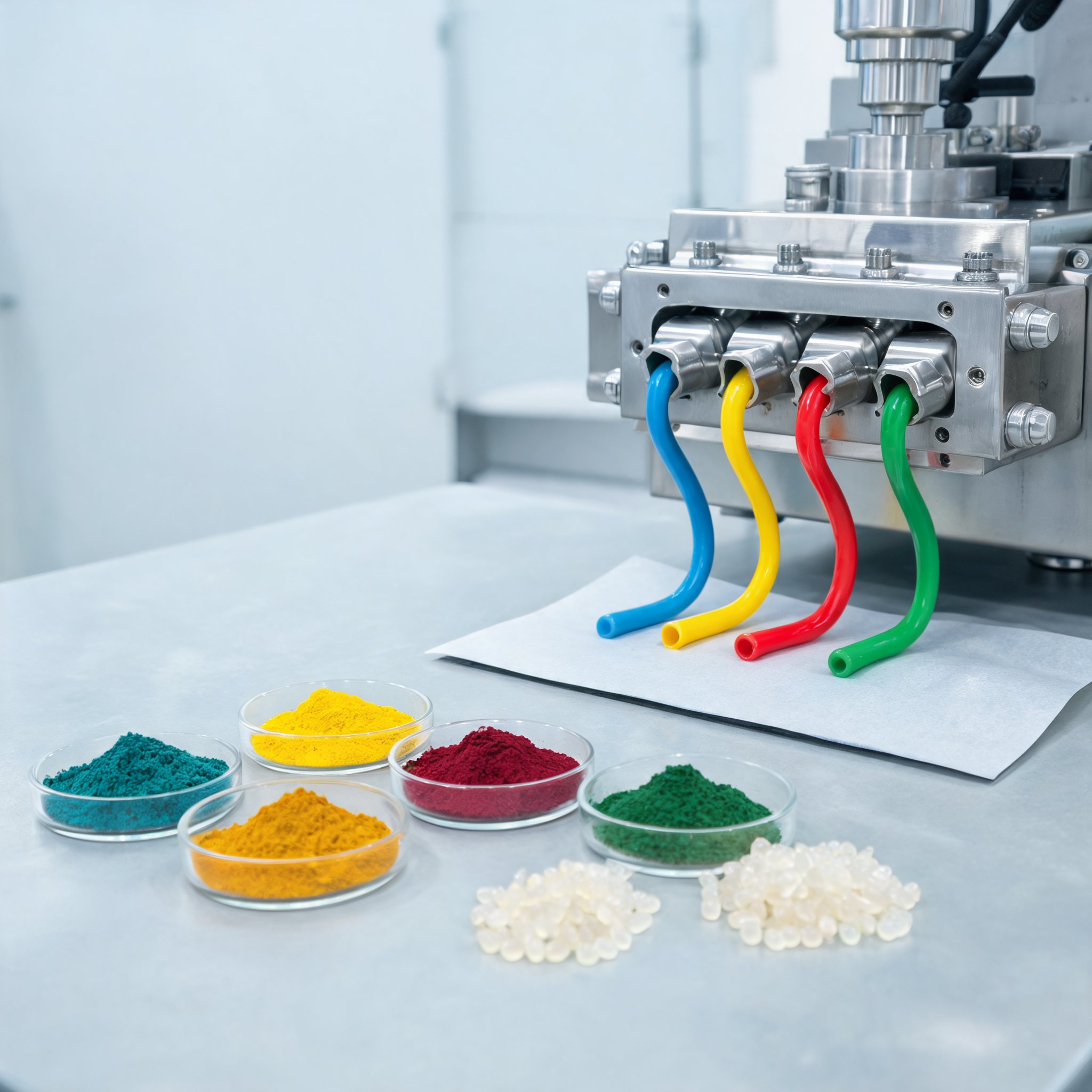
Natural colorants are often treated as a packaging-friendly idea until they meet a real melt-processing line. A study puts four commercial pigments through that test in polylactic acid (PLA) and polybutylene succinate (PBS), using conventional twin-screw compounding and injection molding rather than a specialized laboratory route. The results show that several pigments can be carried through processing at the tested loadings, but they also expose a split between short-term manufacturability and long-term color performance.
The work, titled Sustainability in the Development of Natural Pigment-Based Colour Masterbatches and Their Application in Biopolymers, examined blue spirulina, yellow curcumin, red beetroot and green chlorophyllin. Each was formulated into a color masterbatch with the polymer, then diluted into the matching PLA or PBS matrix at 2, 4 and 6 wt% and injection molded into test specimens. The masterbatch formulation also contained titanium dioxide, calcium carbonate and stearic acid, added to support UV protection, dispersion and processing. This is a practical formulation question, not just a pigment-chemistry question: the additive package and the polymer's thermal profile both shape whether a natural color survives.
A narrow thermal window
The first constraint is heat. Natural pigments are organic structures and can begin to degrade at temperatures below those needed to melt common polymers. Thermogravimetric analysis put the degradation onset at about 229 °C for spirulina, 244 °C for curcumin, 258 °C for chlorophyllin and 267 °C for beetroot. PLA and PBS degrade at considerably higher temperatures, so the pigments sit in a narrower processing window than the matrices.
The researchers therefore set extrusion profiles that melted each polymer while limiting the pigments' thermal exposure. PBS was processed at 145 °C and PLA at 190 °C, with the twin-screw extruder running at 65 rpm and a feed rate of 2 kg/h. That window worked for most pigment-polymer pairs, but not all. During PLA processing, spirulina lost its characteristic blue color, so a blue PLA masterbatch could not be produced. PBS, processed at the lower temperature, preserved enough pigment stability for successful compounding.
That single exception is important for how the results should be read. A degradation onset above the processing temperature did not guarantee color retention in PLA. The study's reported outcome is narrower and more useful: spirulina's viability depended on the matrix and its thermal requirements. For compounders, this means natural-pigment compatibility cannot be assessed pigment by pigment alone. It has to be mapped against the specific polymer, the melt temperature and the resulting processing window. The same logic applies to any natural colorant proposed as a drop-in replacement for a conventional grade.
Flow and mechanical penalties stay modest
On the processing side, the pigments caused only limited changes in rheology. Melt flow rate fell slightly after incorporation, pointing to a modest increase in melt viscosity. Neat PLA had an MFR of about 50 g/10 min, and the natural-pigment masterbatches remained close to that value. PBS showed a similar response, with only a minor reduction. Those are not the kinds of shifts that automatically force a new screw design, pressure setting or molding window, and the study reports that conventional twin-screw compounding and injection molding handled most formulations without major processing problems.
Mechanical performance also stayed close to baseline over the 2-6 wt% masterbatch range. PLA began with a Young's modulus of about 1710 MPa and a tensile strength of 65.6 MPa; PBS began at about 392 MPa and 34.5 MPa. The colored formulations remained near those values. Impact strength stayed in a similar range, although individual pigments produced some variation. The important qualification is that these results cover the tested loadings and formulations, not an open-ended claim that natural pigments are mechanically neutral at any concentration. Within the study's window, however, the usual trade-off between color and toughness did not appear as a major penalty.
Light fastness is the weak point
The weakest result is lightfastness. After 50 hours of xenon-lamp exposure, most formulations showed a color difference above ΔE* = 2, a level generally taken as visually perceptible. The main exception was a PLA formulation containing 2 wt% green chlorophyllin masterbatch, which showed the highest photostability. That is a narrow bright spot. It does not establish a general outdoor-grade natural color system, and it does not remove the need to test each pigment-polymer combination in the intended service environment.
The study therefore identifies UV stability as the largest barrier to broader use. Packaging, consumer products, agricultural parts and outdoor applications may need additional stabilization, protective coatings or pigment modification before natural colors can compete with conventional systems over long service periods. This is a different problem from extrusion. A formulation can be processable, retain useful mechanical properties and still fail the appearance test after exposure. For product developers, the relevant question is not simply whether a natural pigment survives the extruder, but whether the finished part holds color for the required lifetime.
Environmental gains and the limits of the evidence
The environmental comparison favors the natural pigments under the study's assumptions. One kilogram of curcumin pigment generated about 0.04 kg CO2-eq, compared with 18.65 kg CO2-eq for the inorganic green reference pigment. The natural-pigment masterbatches also consumed less electricity during extrusion and pelletizing. Those figures are significant because they address a common objection: that a bio-based colorant may lose its sustainability advantage once processing energy and additive burdens are included. The study's numbers point the other way, at least for the materials and boundaries assessed.
Those figures are study-specific, and the reported comparison should not be treated as a universal life-cycle result. What they do show is that the environmental argument for natural colorants is not purely conceptual. It has a measurable basis in the pigment production and compounding steps examined here, even as the technical case remains constrained by thermal sensitivity and photodegradation.
What would make natural colors viable
The study's overall message is conditional rather than promotional. Several natural colorants can be compounded into PLA and PBS using conventional processing equipment, with limited changes in melt viscosity and mechanical performance. But natural-pigment masterbatches still require development in lightfastness and thermal stability. Future work, the study indicates, should focus on improving color stability during processing and subsequent service exposure.
For industry, that translates into a staged qualification path. First, match pigment to polymer by processing temperature, with spirulina and PLA as the clearest cautionary case. Second, verify that the additive package and masterbatch loading do not erode flow or toughness beyond the application's tolerance. Third, test color retention under the actual exposure conditions, because a 50-hour xenon result already shows perceptible shifts in most formulations. The natural-pigment option is technically credible at the compounding stage; it is not yet a general replacement for conventional colorants in applications where appearance must last.